Your Brain Works Best When It Is Calm: The Science and the Silva Method
Stress turns down the part of your brain that plans and checks. Calm turns it back on. Here is the research, the Silva Method, and a simple practice for your next session.

Think of the last trade you regret. Not a loss that followed your plan. The other kind: the one you knew was wrong while your finger was on the button.
Now remember your body in that moment. Was your jaw tight? Was your breath short? Were you leaning toward the screen?
Most traders who answer honestly say the same thing. They were not calm. And yet, in that moment, the trade felt like a good idea. “I have to get it back” sounded logical.
That does not mean you are weak or stupid. It means your brain was working in a different mode.
Your brain has two modes
Behind your forehead sits the prefrontal cortex. Think of it as the thinking part of your brain. It plans. It keeps your rules in mind. It compares options. It can say “not now” to an urge.
Deeper inside sits the amygdala. Think of it as the alarm part. Its job is to spot danger fast and get you moving. It does not read your trading plan. It reacts.
When you are calm, the thinking part leads. You see the whole chart, not only the last candle. You remember your stop, your size and your daily limit. You can wait for your setup.
When the alarm part fires, your body releases stress chemicals. Your heart beats faster. Your view gets narrow, like looking through a tunnel. The thinking part goes quiet, and fast, old habits take over.
A loss can start exactly this. Your brain treats losing money like a threat. The alarm rings, and the fastest “fix” it can find is to win the money back right now. That is why revenge trading feels so logical while you do it, and so strange an hour later.
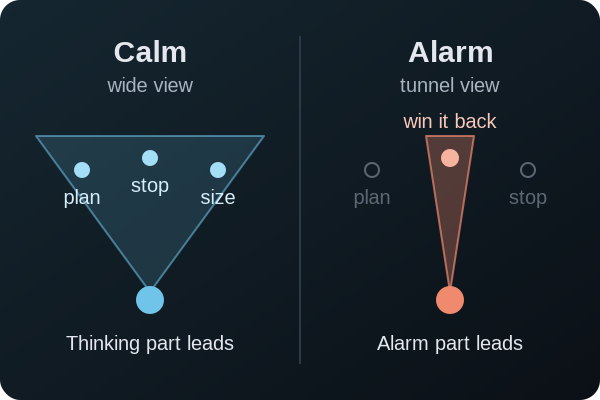
Calm is not a mood. It is what the thinking part of your brain needs to do its job.
What the research found
Here are some of the studies behind this, each in a few lines.
Stress turns down the thinking part
Brain scientist Amy Arnsten at Yale reviewed many years of research. Her summary: even quite mild stress, when it feels out of your control, can cause a fast and strong loss of prefrontal abilities. Stress chemicals weaken the thinking part and give more control to the alarm part and to automatic habits. [1]
Some pressure helps, too much hurts
In 1908, Robert Yerkes and John Dodson trained mice to choose the lighter of two boxes, with mild electric shocks for wrong choices. A medium shock gave the fastest learning, not the strongest one. On the hardest version of the task, the best level was lower. Later, people turned this into a simple rule: you do best with some energy, but not too much. Calm does not mean sleepy. [2]
Traders feel it in their bodies
Andrew Lo and Dmitry Repin at MIT measured skin response (tiny changes in sweat) and heart signals in 10 professional traders during live trading. Their bodies reacted clearly to market events and to periods of fast, jumpy prices, even though they were professionals. The size of the reaction seemed to differ with experience. [3]
Better traders handle feelings early
Mark Fenton-O’Creevy and his team studied traders at four investment banks in London. Emotions were a central part of their decisions. Traders who dealt with feelings early, before they grew, did better than traders who mostly tried to control feelings after they were already strong. [4]
A short calm practice helps you let go of a bad choice
Andrew Hafenbrack and colleagues tested the sunk-cost bias: the pull to stay with a losing choice because of what you already put into it. After a short mindful-breathing session, people were more likely to let go. It pulled their attention away from past and future and lowered bad feelings. For a trader, “I have to get it back” is the same pull. [5]
Slow breathing calms the body and the brain
Andrea Zaccaro and colleagues reviewed 15 studies on breathing slower than 10 breaths a minute. Slow breathing raised heart rate variability: small, healthy changes in the time between heartbeats, a sign that your body can shift between alert and calm. Brain recordings showed more alpha waves, the slower brain rhythm of being relaxed but awake. People felt more relaxed, more comfortable and more alert, with less anxiety. [6]
Breathing training helps with stress and performance
Paul Lehrer and colleagues combined 58 controlled studies of heart rate variability biofeedback. That is training where you breathe slowly, usually close to 6 breaths a minute, while a sensor shows your heart rhythm. They found a small to medium benefit. It was largest for anxiety, anger, and performance in sports and the arts. [7]
Alpha waves rise when attention turns inward
Andreas Fink and Mathias Benedek reviewed brain-wave studies on creative thinking. Alpha waves tend to rise when people come up with new ideas and turn their attention inward, away from outside noise. This quiet, inward state is what the Silva Method aims for. [8]
The Silva Method: relax first, then decide
In the 1960s, José Silva, an electronics repairman from Laredo, Texas, started teaching a course that became known as the Silva Method. He had worked on it since the 1940s. [9]
His main idea is simple: do not try to solve a problem while your mind is noisy. First go to a relaxed, quiet state. Silva called it the “alpha level”, after alpha waves. Then think, picture the result, and decide.
The way in is a short countdown. [10] You close your eyes and look slightly up. You take a deep breath. As you breathe out, you say “3” in your mind three times. On the next breath out, “2” three times. On the next, “1” three times. Beginners then count down from 100 or 50 to go deeper. At that quiet level, you picture what you want to do. To finish, you count up from 1 to 5 and open your eyes.
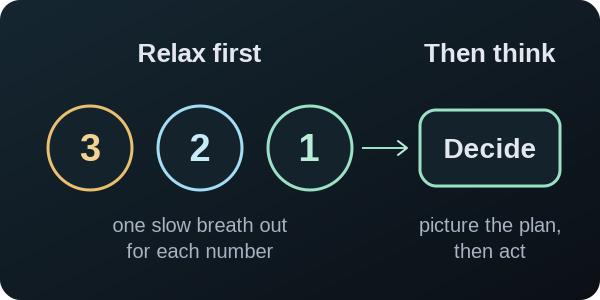
Picturing a task before you do it has a name in science: mental rehearsal, or mental practice. A large review of studies found that it has a real, positive effect on performance. How much it helps depends on the task, on how long you practise, and on how much time passes before the real thing. [11]
So three parts of Silva’s course match the research above:
- Relax first. Calm lets the thinking part lead.
- Breathe slowly. It is linked with a calmer body and more alpha waves.
- Rehearse the task. Studies show that mental practice can help.
A 3-step practice for your trading day
This practice takes a few minutes a day. It cannot promise better results. It gives the thinking part of your brain a fair chance to do its job.
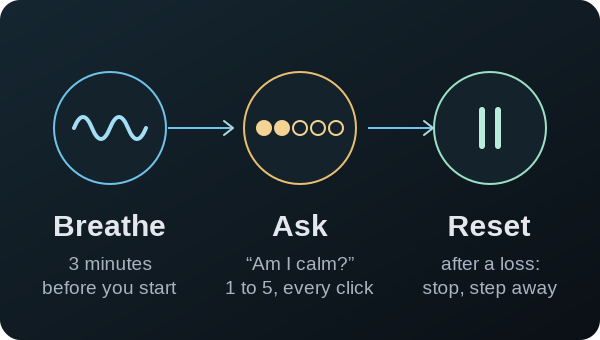
Step 1: Three minutes before the session
Sit back from the screen. Aim for 4 to 6 slow breaths a minute: for example, in through your nose for 4 seconds and out for 6 seconds. Do not force it. Set a timer for 3 minutes so you do not have to count.
If you like Silva’s countdown, add it at the end: say 3, 2 and 1 in your mind, each on a slow breath out. Then picture your plan once, like a short film: the setup you are waiting for, where your stop goes, your size, and you closing the platform when you reach your daily limit.
Step 2: One question before every click
Before every order, take one slow breath and ask: “Am I calm?” Answer with a number from 1 to 5. 1 means calm and clear. 5 means hot, tight and in a hurry.
At 1 or 2, follow your plan. At 3 or higher, take your hand off the mouse and breathe slowly for one minute. Then ask again. If the number does not come down, skip the trade. There will be other setups.
Step 3: After a loss, stop, step away, reset
A loss is the moment your alarm part is most likely to take over. So make the rule before the session starts: after a loss, no new order for a few minutes.
First check that your positions and orders are what you expect. Then stand up. Get some water. Breathe slowly. Come back and ask the question from step 2 again. Trade only if the answer is 1 or 2 and the next setup is in your plan. If you hit your daily loss limit, the session is over, however calm you feel.
If you need more than a few minutes, read how to take a trading break. If the pull is “I must win it back”, the guide on how to stop revenge trading has a full checklist.
Calm first, then the click
Your strategy and your risk rules live in the thinking part of your brain. Stress turns it down. Calm turns it back on. José Silva taught “relax first, then decide” in the 1960s. Research since then helps explain why that order makes sense.
You will not stop feeling things, and you do not need to. Good traders feel fear and frustration too. The difference is what happens next: they notice it early and give their brain a moment to get back to calm before they act.
ZoneKeeper is built for that moment. Before the next trade, you rate your tilt from 1 (calm) to 10, and the scale tells you whether to follow your plan, reset, or stop for the day. After a loss, a short guided audio reset helps you pause and check in again before you decide. The Breathe screen guides a “Longer exhale” rhythm: 4 seconds in, 6 seconds out, the same as step 1. None of this can turn a trade into a winner. It can help you make the next decision from a calm place.
Want to hear what a ZoneKeeper reset sounds like? The free full audio sample is for “I need to make it back” after a loss, with no account or card required. Plans and the trial are on the pricing page.