Why Trading Needs a Different Way of Thinking
You work hard. You solve problems. When something goes wrong, you push harder.
That may have helped you build a career or learn a skill. So you bring the same drive to trading.
Then a strange thing happens: the harder you try to force a good result, the worse your decisions become.
You may not need more willpower. You may need to use your strengths in a different way.
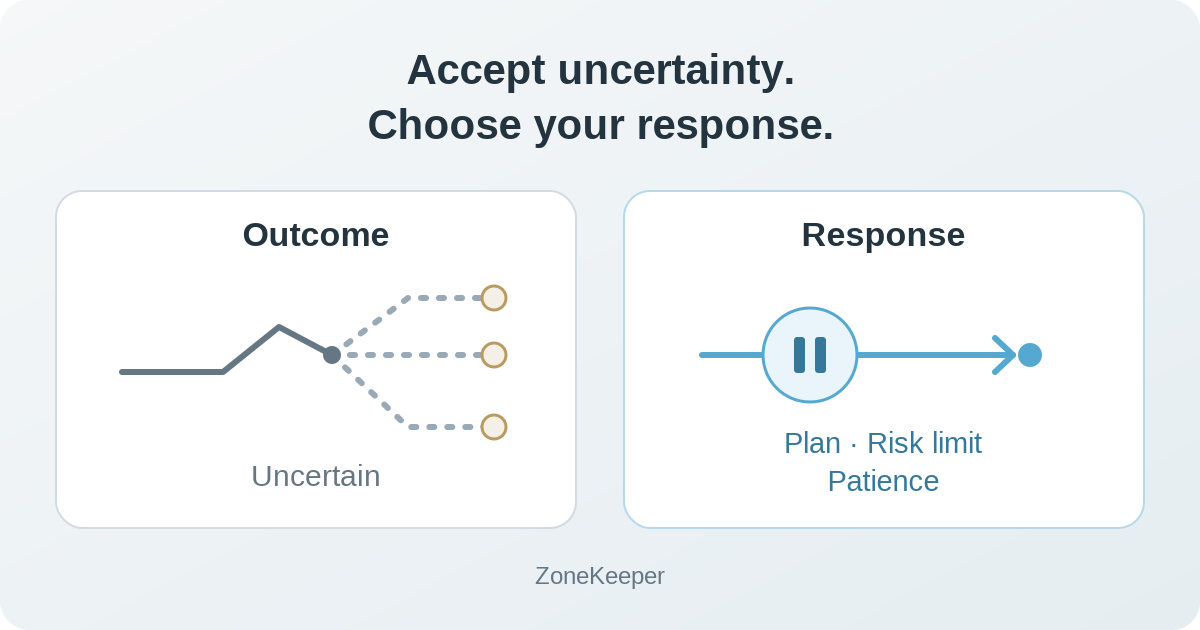
The rules feel different here
Many of us learned that getting the right answer means doing well. Trading gives less clear feedback. A careful trade can lose. A poor trade can win by luck.
Other parts of life have uncertainty too. Trading simply makes the gap between a good decision and a good result hard to ignore.
Here are four useful shifts:
| Old habit | Trading habit |
|---|---|
| I must be right. | I can be wrong and still follow a sound plan. |
| Try harder when things go badly. | Pause and check before taking more risk. |
| Never give up. | Stay committed to learning; let go of a failed trade idea. |
| More action means more progress. | Waiting can be the right decision. |
This change is hard because the old habits feel responsible. Holding a loss can feel like courage. Chasing a move can feel like taking action. But the market does not reward how badly you want something.
What psychologists can teach us
Psychologist Daniel Kahneman described how losses can affect us more strongly than equal gains. That helps explain why a loss can feel so urgent. Wanting to make it back is a feeling, not evidence that the next trade is good. [1]
Psychologist and trading coach Brett Steenbarger describes traders whose need to be right gets in the way of reading the market. His lesson is useful: a trade does not need to prove how smart you are. [2]
Trading author and coach Mark Douglas made learning to accept risk and think in probabilities central to Trading in the Zone. In simple words: a good chance is still not a promise. [3]
These ideas explain part of the challenge. They do not prove that mindset alone makes a trader profitable. You also need a method supported by evidence, realistic costs, and limits on risk.
How to practise the new way
Start with one behaviour, not a promise to become a different person overnight.
- Before entering, write down why the trade fits your plan, where the idea fails, and your risk limit. A stop order cannot guarantee the exact exit price.
- After the trade, ask two separate questions: Did I follow a sound plan? What was the result? Record both. A win does not excuse a broken rule; one loss does not prove a method is bad.
- Choose one if-then rule: If I feel the urge to win it back, then I take my hand off the mouse and pause before another entry.
- Review a group of trades later. Look at results after costs as well as behaviour. Following a weak plan perfectly will not make it work.
Psychologist Peter Gollwitzer and colleagues have studied these if-then plans. Their research supports planning a clear response to a clear trigger. The trading example above is a practical use of that idea, not a proven profit formula. [4]
You do not have to feel fearless
The aim is to notice the feeling without letting it choose your next trade.
You can feel disappointed and still respect your limit. You can miss a move and still wait. You can be wrong without turning it into a fight with yourself.
That is a useful kind of confidence: I do not know what the next trade will bring. I know how I want to respond.
Practise that next response. Then practise it again.
Need a pause between trades? Try the short reset on the ZoneKeeper home page.