Holy Grail: The Three Parts of Trading
Strategy. Money management. Psychology. It took me years to understand why I needed all three.
For years, I tried to make trading work with two things: a strategy and money management. I kept working on both, without the success I was looking for. It took me years to understand what was missing.
The third part was psychology. And for me, it was the hardest one to face.
Three circles. One whole.
I now picture trading as three circles that overlap.
- Strategy — A tested reason to enter, wait, or exit.
- Money management — A clear limit on what I can lose, and a position size that respects it.
- Psychology — The ability to follow those rules when fear, hope, or anger pulls me away.
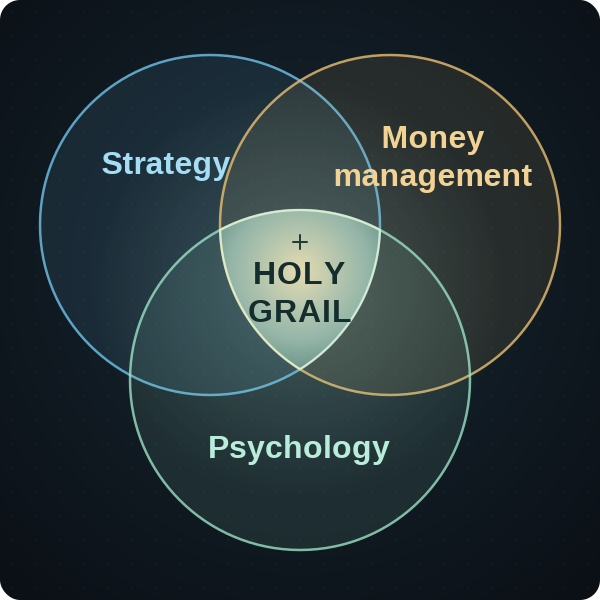
A strategy cannot protect me if I ignore my risk limit. A risk limit cannot protect me if I move it. And calm alone cannot make a weak strategy work. All three need attention. Even together, they cannot promise a profit.
The hardest thing to admit
It is easy to spend years improving the first two circles. I did. Charts and numbers felt easier to work on than my own reactions.
The hard part was admitting this: I could know what to do and still feel pulled to do the opposite.
After a loss, that pull might say, “Get it back.” After a missed move, “Get in now.” In that moment, another promise to be disciplined was not enough for me.
I had to admit that I could not rely on willpower alone to fight every impulse. I needed a way to notice the pull and pause before acting on it.
That admission hurt. But it also gave me a place to begin.
What Alexander Elder helped me understand
In Trading for a Living, Alexander Elder draws a comparison between harmful trading patterns and the denial he saw around alcohol addiction. He uses lessons from Alcoholics Anonymous to discuss facing a problem honestly. [1]
AA’s first step asks a person to admit being powerless over alcohol and that their life has become unmanageable. [2]
For me, the trading lesson was simple: I cannot work on a pattern while I keep telling myself it is not there.
This comparison does not mean every trader who breaks a rule has an addiction. It helped me see my own need to stop making excuses and start taking the pattern seriously.
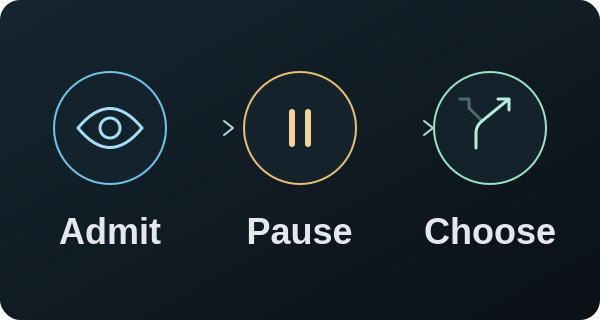
The next stage starts with honesty
I used to think the next stage would begin when I found a better setup. Now I see it as the point where I take my own behavior as seriously as my strategy and my risk.
That is the kind of trader I want to become: someone who gives all three circles a place in every decision.
Admitting the problem is a beginning. The work is in what follows: noticing the urge, respecting the limit, and stepping away when I cannot follow my plan.
I also have to keep remembering this. A good week does not mean an old pattern is gone. If I stop paying attention, I can fall back into it.
That is a topic for another article. For now, the first step is enough to name: be honest about the third circle.
I spent years looking for the holy grail. I was leaving part of it out.
Read next: Why Trading Needs a Different Way of Thinking.